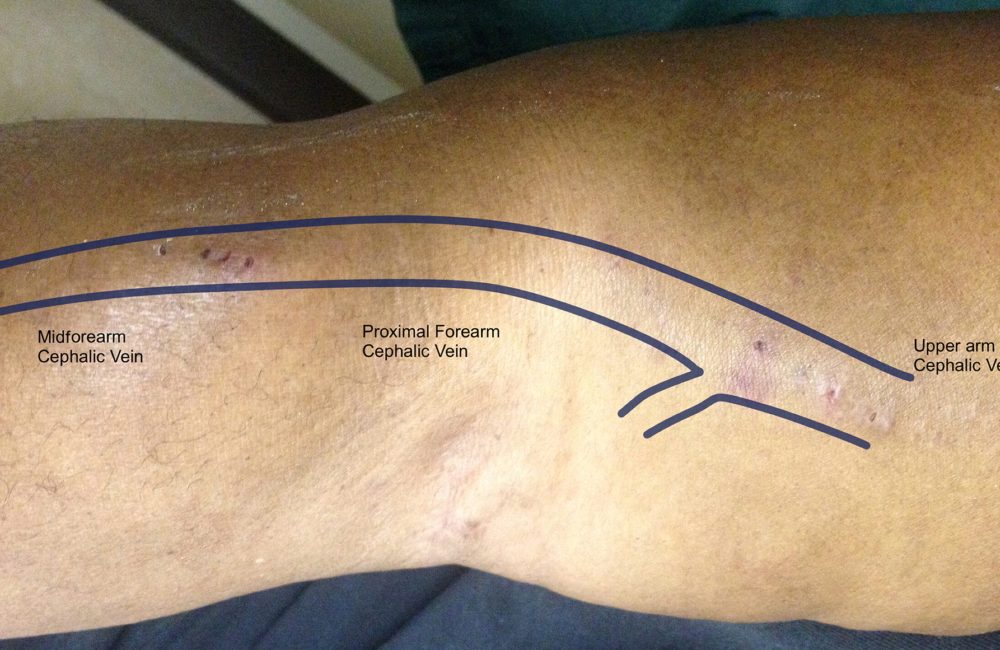
Basilic Vein Transposition (BVT) is a surgical procedure commonly performed in patients with end-stage renal disease who require long-term hemodialysis access. When the cephalic vein or other superficial veins are not suitable for creating an arteriovenous fistula (AVF), the basilic vein becomes an excellent alternative due to its size and flow characteristics. However, because it lies deep within the arm, it needs to be surgically repositioned closer to the skin surface for easy needle access. BVT is a vital option for ensuring reliable dialysis access and improving quality of life for patients who depend on hemodialysis.
The basilic vein is a large, prominent vein located along the inner (medial) side of the upper arm. Unlike the cephalic vein, which is more superficial, the basilic vein runs deep under the skin and fat, making it less accessible for dialysis needle insertion. Its size, length, and proximity to the brachial artery make it suitable for creating a durable AVF once it is transposed to a superficial location.
The procedure involves surgically mobilizing and relocating the vein to a more superficial position, often tunneling it under the skin, so it can be connected to the brachial artery. This allows repeated needle punctures for dialysis without compromising blood flow.
Basilic vein transposition is not performed because of a disease affecting the vein itself, but rather as a treatment for patients requiring vascular access for hemodialysis. Common scenarios where BVT is considered include:
Failure of other access sites – when the cephalic vein or forearm vessels are unsuitable due to thrombosis, scarring, or previous procedures.
Small or sclerosed veins – limiting the creation of a radio-cephalic or brachio-cephalic AVF.
Preservation of future access sites – when other superficial veins need to be spared for possible future use.
Patient-specific anatomy – in some individuals, the basilic vein provides the best option for a durable, high-flow access.
Since BVT is an elective surgical procedure, patients do not typically present with symptoms of basilic vein disease. Instead, the clinical “presentation” usually involves:
End-stage renal disease requiring long-term hemodialysis.
Previous AVFs that have failed or thrombosed.
Difficulty achieving reliable dialysis through existing vascular access.
Limited superficial vein availability on ultrasound mapping.
The decision to proceed with basilic vein transposition is made after careful vascular evaluation. Diagnosis and assessment involve:
Clinical examination – assessing the patient’s arm veins, pulses, and history of previous vascular access procedures.
Duplex ultrasound mapping – to measure the size, patency, and quality of the basilic vein and nearby arteries.
Review of patient history – including prior access attempts, clotting disorders, or surgical scars.
Imaging if necessary – venography or advanced imaging may be used if ultrasound findings are inconclusive.
Non-surgical options are limited since hemodialysis requires a reliable vascular access. Alternatives to AVFs include:
Central venous catheters (CVCs): Temporary access but associated with higher infection and thrombosis risks.
Peritoneal dialysis: An alternative dialysis method for some patients, though not suitable for everyone.
Radio-cephalic AVF: First choice if suitable wrist veins are available.
Brachio-cephalic AVF: Preferred if cephalic vein at the elbow is adequate.
Basilic vein transposition: Chosen when other AVFs are not possible.
Prosthetic grafts: Used when no native veins are usable, but carry higher complication risks compared to BVT.
Basilic vein transposition is usually performed under regional or general anesthesia. The key steps include:
Incision and vein mobilization: The basilic vein is exposed along the upper arm and carefully dissected free from surrounding tissues.
Creation of a superficial tunnel: A channel is made just under the skin to reposition the vein.
Transposition: The basilic vein is moved through the superficial tunnel to a more accessible location.
Anastomosis (connection): The vein is connected to the brachial artery to create a functional arteriovenous fistula.
Closure: The incisions are closed, and the fistula is checked for proper blood flow (“thrill” or vibration).
Recovery and care after BVT are crucial for long-term success:
Wound care: Keeping the surgical site clean and dry to reduce infection risk.
Monitoring: Checking for adequate fistula function (presence of thrill and bruit).
Exercise: Gentle hand and arm exercises may help promote fistula maturation.
Follow-up imaging: Duplex ultrasound to ensure good flow and detect early complications.
Maturation period: Typically 6–12 weeks are needed before the fistula is ready for regular dialysis use.
Like any surgical procedure, BVT carries some risks:
Infection at the surgical site.
Bleeding or hematoma formation.
Thrombosis leading to fistula failure.
Nerve injury causing numbness or weakness in the arm.
Steal syndrome (reduced blood supply to the hand).
Prolonged maturation time or inadequate flow.
Basilic vein transposition has a high success rate when performed in appropriate patients. Compared to prosthetic grafts, native vein fistulas (including BVT) tend to last longer, have lower infection rates, and provide better dialysis adequacy. With proper care and regular monitoring, BVT can function effectively for years, significantly improving the patient’s quality of life.
Patients should seek medical attention if they experience:
Swelling, redness, or pus at the surgical site.
Severe pain, numbness, or weakness in the arm.
Absence of the usual thrill or bruit from the fistula.
Signs of poor circulation in the hand (coldness, discoloration).
Sudden bleeding from the fistula site.
Basilic vein transposition is a well-established surgical technique that provides reliable vascular access for hemodialysis when other superficial veins are unsuitable. By bringing the deep basilic vein closer to the skin surface and connecting it to the brachial artery, this procedure creates a durable and functional arteriovenous fistula. With careful surgical planning, diligent postoperative care, and timely monitoring, patients can achieve long-term dialysis access and improved treatment outcomes.


Aenean porta orci nam commodo felis hac ridiculus fusce fames maximus erat sed dictumst blandit arcu suspendisse sollicitudin luctus in nec