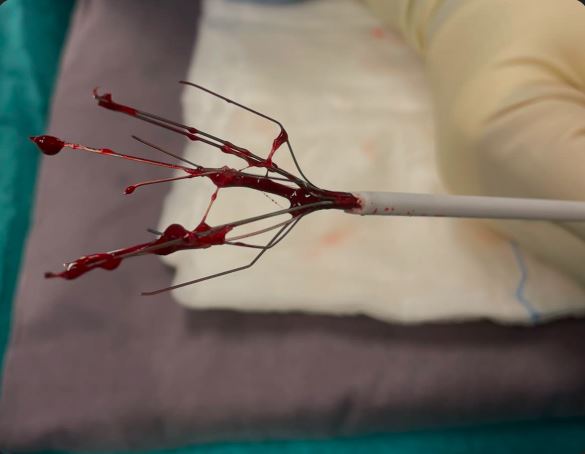
An Inferior Vena Cava (IVC) filter insertion is a minimally invasive procedure used to prevent pulmonary embolism (PE)—a potentially life-threatening condition caused by blood clots traveling to the lungs. The IVC filter is a small, metal device placed inside the inferior vena cava (the large vein that carries blood from the lower body to the heart). It acts like a sieve, trapping large blood clots before they reach the lungs while still allowing blood to flow.
This procedure is especially important for patients at high risk of blood clots who cannot take blood-thinning medications, or for those in whom these medications are not effective.
The inferior vena cava (IVC) is the largest vein in the body, running from the lower abdomen up to the heart. It collects blood from the legs, pelvis, and abdomen.
Blood clots often form in the deep veins of the legs or pelvis—a condition known as deep vein thrombosis (DVT). If a clot breaks off, it can travel through the IVC to the lungs, causing a pulmonary embolism.
The IVC filter is designed to catch these clots, giving the body time to break them down naturally and reducing the risk of PE.
IVC filters are used in patients at high risk of pulmonary embolism due to:
Deep vein thrombosis (DVT).
History of pulmonary embolism.
Contraindication to anticoagulation therapy (blood thinners not safe due to bleeding risks).
Failure of anticoagulation (clots develop despite medication).
High risk of clot formation in trauma patients, after major surgery, or in immobile/critically ill patients.
Risk factors for clot formation include:
Prolonged immobility (bed rest, long flights).
Recent major surgery or trauma.
Cancer.
Obesity.
Pregnancy and postpartum period.
Genetic clotting disorders.
IVC filter insertion itself is a treatment, not a disease, but patients who require it often present with symptoms of DVT or PE:
Deep Vein Thrombosis (DVT):
Swelling in one or both legs.
Leg pain or tenderness, often in the calf.
Warmth, redness, or skin discoloration.
Pulmonary Embolism (PE):
Sudden shortness of breath.
Chest pain (sharp, worse with breathing).
Rapid heart rate.
Coughing, sometimes with blood.
Lightheadedness or fainting.
Before recommending IVC filter insertion, doctors evaluate for DVT or PE through:
Clinical examination (checking leg swelling, tenderness, or risk factors).
Doppler ultrasound of the legs to detect clots.
CT pulmonary angiography to confirm pulmonary embolism.
Blood tests such as D-dimer (screening for clot breakdown products).
Echocardiogram (in selected cases to assess heart strain from PE).
Anticoagulation (blood thinners): First-line treatment for most patients with DVT or PE.
Thrombolysis (clot-busting drugs): Used in severe cases.
Compression stockings: Reduce swelling and prevent clot progression.
When blood thinners are unsafe or ineffective, IVC filter insertion becomes the preferred option. Filters can be:
Permanent filters: Left in place indefinitely.
Retrievable filters: Can be removed later once the risk of clotting decreases.
The procedure is performed by an interventional radiologist or vascular surgeon under local anesthesia with sedation.
Steps include:
Preparation: Patient lies on the procedure table; IV access and monitoring are set up.
Access: A small incision is made in a vein (commonly the neck or groin).
Catheter insertion: A thin tube (catheter) is guided into the IVC using X-ray imaging.
Filter placement: The IVC filter is deployed inside the vein, expanding to anchor itself against the vein walls.
Confirmation: Imaging ensures correct placement.
Completion: The catheter is removed, and a small bandage is applied.
The entire procedure usually takes 30–60 minutes. Patients are often discharged the same day or after a short observation period.
Hospital stay: Usually same-day discharge or overnight observation.
Activity: Patients can resume normal activities within 24 hours.
Medications: Blood thinners may still be prescribed if safe.
Wound care: Keep insertion site clean and dry.
Follow-up imaging: Regular ultrasound or X-rays to check filter position and function.
Filter retrieval: For retrievable filters, removal is planned once the clotting risk subsides (weeks to months later).
IVC filter insertion is generally safe, but potential risks include:
Procedure-related risks: Bleeding, infection, vein injury.
Filter-related complications:
Migration (filter moving from original site).
Tilting or misplacement.
Breakage of filter struts.
Blockage of the IVC due to trapped clots.
Long-term risks: Increased chance of DVT if the filter is left in permanently.
The prognosis after IVC filter insertion depends on the underlying condition and overall health:
Short-term: Highly effective in reducing the risk of pulmonary embolism.
Long-term: Most patients do well, especially if the filter is removed when no longer needed.
Complications: Rare but can occur with long-term permanent filters, highlighting the importance of follow-up care.
Seek medical attention if you experience:
New or worsening leg pain, swelling, or redness.
Sudden chest pain or shortness of breath.
Unexplained fever or infection at the insertion site.
Signs of circulation problems in the legs (coldness, discoloration).
IVC filter insertion is a valuable, life-saving procedure for patients at high risk of pulmonary embolism who cannot take blood thinners or when these medications are not sufficient. The procedure is quick, minimally invasive, and highly effective in preventing life-threatening complications.
However, filters are not without risks, and regular follow-up is essential, especially for retrievable filters. Anyone with symptoms of DVT or PE should seek prompt medical evaluation. Early diagnosis and treatment are crucial to preventing serious outcomes.


Aenean porta orci nam commodo felis hac ridiculus fusce fames maximus erat sed dictumst blandit arcu suspendisse sollicitudin luctus in nec